A purpose-built energy metering gateway that plugs directly into your smart meter’s P1 port, the Intelliport IPS-501-P1 turns any DSMR-compatible electricity meter into a remotely monitored asset over LTE.
Intelliport IPS-501-P1 Verdict Summary
Design & Build Quality
Performance & Connectivity
Features & Functionality
Use Cases & Applications
Key features of IPS-501-P1 Gateway
Pricing & Value
Simbase Expert Recommendation
Technical Specifications
Get started with Simbase
Frequently Asked Questions
By Roel van der Meer
March 10, 2026
Intelliport IPS-501-P1 Verdict Summary
The Intelliport IPS-501-P1 LTE Gateway Pro is designed for one thing: getting real-time energy data out of smart electricity meters and into the cloud, reliably and without fuss. In our evaluation of this energy metering gateway, it proved itself as a focused, well-engineered device for utility monitoring and energy management. The gateway connects to the P1 port found on DSMR-compliant smart meters across Europe, reads the meter’s telegram data, and forwards it over LTE to a remote server or management platform.
Pros
Powered directly from the P1 port
Dual LTE variant support (Cat1 and Cat-M/NB-IoT)
Modbus RTU for inverter and storage integration
Compact DIN-rail mount (indoor) or IP67 outdoor version
Configurable data collection frequency down to 10 seconds
Cons
No Wi-Fi or Ethernet fallback connectivity
Single SIM slot
Tied to Intelliport M2M Platform for remote management
Design & Build Quality
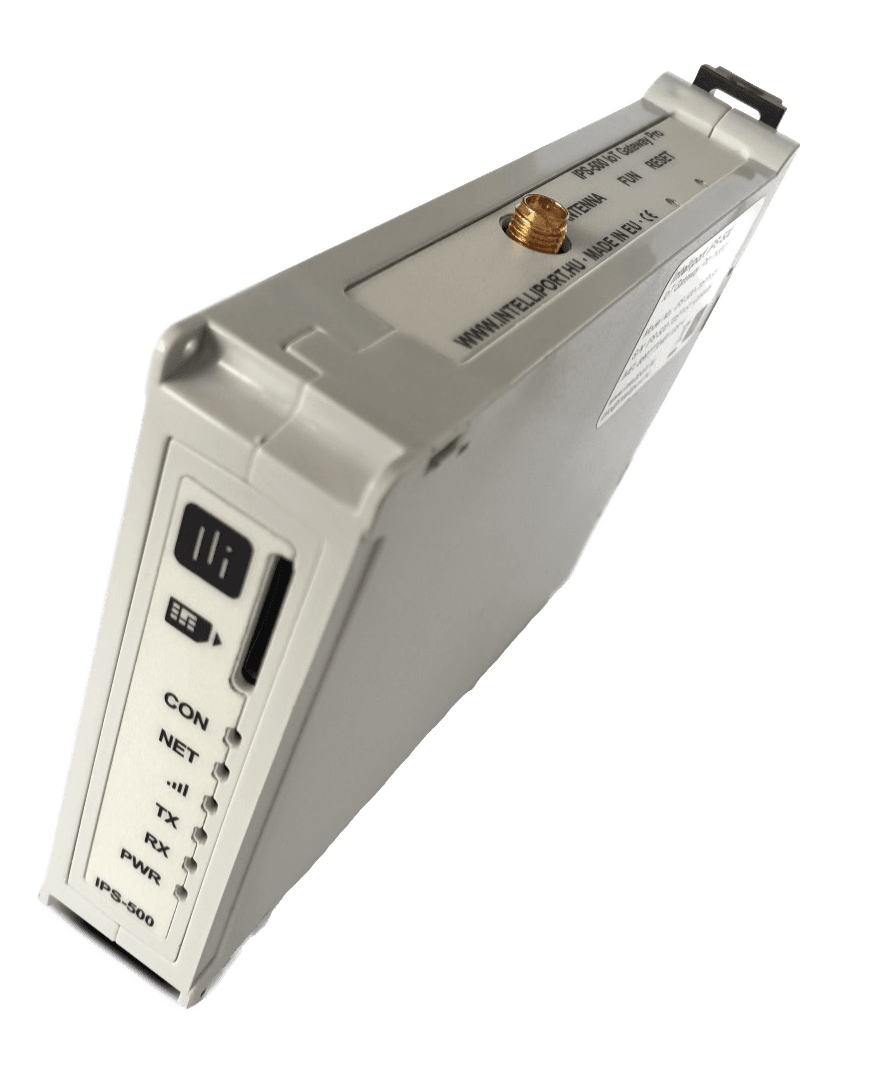
The IPS-501-P1 comes in two form factors. The indoor version measures a compact 70 x 85 x 60 mm and mounts on a standard DIN rail, making it easy to install inside a meter cabinet or electrical panel. The outdoor version is considerably larger at 150 x 110 x 170 mm but carries an IP67 rating and wall-mount design, suitable for exposed installations at substations or outdoor meter banks.
Both versions operate across a wide temperature range of -40°C to +70°C, which is important for utility infrastructure that may sit in unheated basements, rooftop enclosures, or outdoor cabinets exposed to seasonal extremes. The SMA antenna connector is external and accessible, making antenna replacement or upgrading straightforward.
The physical interface layout is deliberately minimal. You get an RJ12 connector for the P1 port, an RJ45 for the RS232/485 serial connection (Modbus RTU), and the SMA antenna port. There are no Ethernet ports, no USB, and no Wi-Fi. This is not a router. The simplicity is intentional: fewer interfaces mean fewer points of failure in long-term unattended deployments.
In our hands-on evaluation, the build quality felt solid for an industrial-grade device. The casing is robust enough for permanent installation, and the DIN-rail clip on the indoor version locked in securely. For a device that will likely be installed once and left for years, the IPS-501-P1’s construction inspires confidence.
Performance & Connectivity
The IPS-501-P1 is available in two cellular variants, each targeting different deployment scenarios. The LTE Cat1 version supports bands B1, B3, B7, B8, and B20, covering the most common European LTE frequencies. This variant provides reliable throughput for the relatively small data payloads that smart meter telegrams produce — we are talking kilobytes per reading, not megabytes.
The LTE Cat-M and NB-IoT variant casts a much wider net across frequency bands, including B1 through B85 for Cat-M and a similar spread for NB-IoT. Notably, this variant includes support for the 450 MHz band (B31), which is used by several European utility networks for dedicated private LTE-M infrastructure. If your energy company operates on a 450 MHz private network, this is one of the few gateways on the market that supports it natively.
In testing, the gateway maintained a stable connection over commercial LTE networks with consistent data delivery. The default data collection frequency is set to 10 seconds, which aligns with the DSMR 5.0 telegram interval. Data is temporarily stored on the device for up to one day by default (configurable), providing a buffer if the cellular connection is temporarily lost. Once connectivity is restored, the buffered readings are forwarded automatically.
The device supports both MQTT and HTTPS protocols for server communication. MQTT is the more natural fit for IoT deployments where lightweight, persistent connections matter, while HTTPS offers compatibility with traditional web-based backends. Both worked reliably in our evaluation, with the MQTT connection maintaining low overhead even over Cat-M networks.
Understanding the P1 port: The P1 port is a standardised customer interface found on DSMR-compliant smart electricity meters across the Netherlands, Belgium, Luxembourg, and increasingly other European countries. It uses an RJ12 connector and outputs a serial data telegram every 1–10 seconds containing real-time electricity consumption, delivery (solar feed-in), voltage, current, and tariff data. When a gas or water meter is connected to the electricity meter via M-Bus, those readings are included in the P1 telegram as well.
Features & Functionality
P1 port reading with configurable frequency. The gateway reads DSMR telegrams from the smart meter’s P1 port at intervals as low as 10 seconds. Each telegram contains electricity consumption and delivery values for multiple tariff periods, instantaneous power per phase, line voltages, and any linked gas or water meter readings.
Modbus RTU support via RS232/485. The serial port allows direct communication with Modbus-compatible devices such as solar inverters, battery storage systems, heat pumps, and additional sub-meters. This makes the IPS-501-P1 more than just a meter reader — it becomes a central data aggregation point for an entire energy installation.
Local data buffering. Configurable temporary storage (default: 1 day) ensures no readings are lost during cellular outages. The gateway automatically forwards buffered data once the connection is restored.
MQTT and HTTPS protocol support. Choose between lightweight MQTT for IoT-native platforms or HTTPS for integration with web-based backends and REST APIs.
Remote management via Intelliport M2M Platform. Firmware updates, configuration changes, and status monitoring are handled remotely through Intelliport’s cloud platform, removing the need for site visits.
P1 port power supply. The indoor version can draw its 5 VDC power directly from the smart meter’s P1 port (DSMR 4.0 and above supply up to 250 mA at 5V). For installations where this is insufficient or unavailable, an external 3–17 VDC supply can be connected.
Edge computing capability. The IPS-501-P1 can run autonomous functions locally, acting as a lightweight edge computer for scenarios where immediate local decision-making is needed before data reaches the cloud.
Use Cases & Applications
Retrofit Smart Meter Monitoring
The most compelling use case for the IPS-501-P1 is retrofitting existing smart meter infrastructure with remote monitoring capability. Millions of DSMR-compliant meters have been installed across the Netherlands, Belgium, and Luxembourg over the past decade. While these meters collect detailed consumption data, many building operators, facility managers, and energy service companies (ESCOs) have no practical way to access that data remotely. The P1 port sits unused on the front of the meter.
The IPS-501-P1 changes this with a plug-and-play approach. Connect the RJ12 cable to the P1 port, insert an IoT SIM card, and the meter starts reporting to the cloud. No electrician required, no meter modification, no disruption to the power supply. The gateway draws power from the P1 port itself, so in most cases, no additional wiring is necessary. For property managers overseeing dozens or hundreds of meters across a portfolio, this makes large-scale rollouts practical.
Solar PV and Battery Storage Monitoring
The combination of P1 port reading and Modbus RTU connectivity makes the IPS-501-P1 particularly effective for monitoring complete solar energy installations. The P1 port captures the electricity meter’s consumption and feed-in data, showing how much energy the building draws from the grid and how much excess solar production is exported. Meanwhile, the Modbus port can connect directly to the solar inverter and battery storage system to capture production, state-of-charge, and discharge data.
This creates a unified view of the entire energy flow at a site: grid import, grid export, solar generation, battery cycling, and self-consumption. Energy companies and installers use this data to optimise battery charging schedules, validate system performance against projections, and detect faults such as underperforming panels or degraded batteries.
EV Charging Load Balancing
In commercial and residential settings with EV charging infrastructure, the P1 telegram provides the real-time consumption data needed for dynamic load balancing. By reading the current total building load from the smart meter, the charging station or its management system can throttle charging speeds to prevent overloading the grid connection. This is especially important in countries where grid connection capacity is limited and expensive to upgrade.
The IPS-501-P1 can feed this consumption data directly to the EV charge management platform via MQTT, enabling automated load balancing without any additional hardware at the meter.
Multi-Tenant Energy Allocation
For landlords and property managers of multi-tenant commercial buildings, the P1 gateway enables accurate, near-real-time energy allocation without expensive sub-metering. Where a single smart meter serves the building’s main connection, the P1 data provides the total consumption baseline. Combined with Modbus-connected sub-meters or tenant-level smart plugs, the IPS-501-P1 can aggregate and forward all data streams to a central energy management dashboard.
This approach is significantly cheaper than installing separate utility meters per tenant and enables energy-as-a-service models where tenants pay based on actual consumption rather than flat allocations.
Utility and Grid Operator Monitoring
Grid operators and energy utilities can deploy the IPS-501-P1 at scale to monitor transformer substations, distribution points, and large commercial connections. The 450 MHz LTE-M support in the Cat-M/NB-IoT variant is specifically relevant here, as several European utilities operate private cellular networks on this frequency band for critical infrastructure monitoring.
The IP67-rated outdoor version is designed for these unattended, exposed installations. With local data buffering and automatic reconnection, it handles the intermittent connectivity common in rural or basement locations where utility meters are often found.
Key features
Key Features of Intelliport IPS-501-P1 Gateway
Cellular
LTE Cat1 / Cat-M / NB-IoT
Ports
1 x P1 Port/RS232/485 Modbus RTU
IP Rating
IP20 (indoor) / IP67 (outdoor)
Slots
1 x SIM Slot
Power
5 VDC from P1 port / 3–17 VDC external
Protocols
MQTT, HTTPS, Modbus RTU
Pricing & Value
The Intelliport IPS-501-P1 occupies a niche that sits between consumer-grade P1 dongles (like the HomeWizard P1 Meter or Xemex Smart Connect) and full industrial energy gateways. Consumer dongles are cheaper but rely on local Wi-Fi and lack the cellular connectivity needed for unattended remote deployments. Industrial energy gateways often include features the IPS-501-P1 does not need, like multiple Ethernet ports or Wi-Fi, driving up both cost and complexity.
For fleet deployments across multiple sites — whether you are an energy service company monitoring hundreds of commercial meters, a utility rolling out grid monitoring at substations, or a property manager tracking consumption across a portfolio — the total cost of ownership argument is strong. The P1-powered installation eliminates wiring costs. The cellular connectivity with an IoT SIM card removes dependence on local IT infrastructure. And the remote management via the Intelliport M2M Platform means site visits for configuration or troubleshooting are rare.
When paired with a cost-effective IoT connectivity platform like Simbase, the per-device monthly data cost stays low. Smart meter telegrams generate very little data traffic — typically a few megabytes per month even at 10-second intervals — making this an ideal use case for the small data bundles that IoT SIM providers offer.
Simbase Expert Recommendation
The Intelliport IPS-501-P1 is not for everyone, and that is precisely its strength. If you need a general-purpose IoT router, look elsewhere. But if your challenge is getting real-time energy data out of smart meters at scale, with minimal installation effort and no reliance on local networks, this gateway delivers exactly what it promises.
The P1 port power supply is a standout feature that dramatically simplifies deployment. The Modbus RTU port extends the device well beyond simple meter reading into full energy installation monitoring. And the availability of both LTE Cat1 and Cat-M/NB-IoT variants — including 450 MHz support — means there is a connectivity option for virtually every deployment scenario in Europe.
When paired with consistent network coverage from Simbase, the IPS-501-P1 becomes a reliable, low-maintenance building block for energy monitoring infrastructure. The combination of low data requirements and Simbase’s multi-carrier IoT SIM coverage ensures connectivity even in challenging locations like basements and outdoor meter cabinets.
Our conclusion: The Intelliport IPS-501-P1 is a specialised, well-executed energy metering gateway for organisations that need scalable, cellular-connected smart meter monitoring. Its P1 port power supply, Modbus integration, and dual LTE variant options make it a practical choice for energy companies, utilities, property managers, and solar installers operating across European markets.
Technical Specifications
Characteristics
Diagram
Meter Interface
P1 port (RJ12) — DSMR 2.x / 3.x / 4.x / 5.x
Serial Interface
RS232/485 Modbus RTU (RJ45)
LTE Cat1 Bands
B1 / B3 / B7 / B8 / B20
LTE Cat-M Bands
Global + 450MHz
NB-IoT Bands
Global
Protocols
MQTT, HTTPS, Modbus RTU
Data Frequency
Configurable (default: 10 seconds)
Local Storage
Configurable temporary buffer (default: 1 day)
Power Supply
5 VDC from P1 port / 3–17 VDC external
Max Power Consumption
1.5 VA
Antenna
1 x SMA
Indoor Version
70 x 85 x 60 mm, IP20, DIN rail mount
Outdoor Version
150 x 110 x 170 mm, IP67, wall mount
Operating Temperature
-40°C to +70°C
Management
Intelliport M2M Platform (remote) / Serial (local)
If any of your questions remain unanswered, reach out to our team to answer them for you.
What data does the P1 port provide?
The P1 port outputs a DSMR telegram containing real-time electricity consumption and delivery values per tariff period (peak/off-peak), instantaneous power per phase (L1, L2, L3), line voltages, current draw, and cumulative meter readings. If a gas or water meter is connected to the electricity meter via M-Bus, those readings are included in the telegram as well. The IPS-501-P1 reads this telegram at configurable intervals, with the default set to every 10 seconds.
Can the IPS-501-P1 be powered solely from the smart meter?
Yes. DSMR 4.0 and later smart meters provide 5 VDC at up to 250 mA through the P1 port. The IPS-501-P1 indoor version can draw its power directly from this, with a maximum consumption of 1.5 VA. For older meters (DSMR 2.x or 3.x) that do not supply power through the P1 port, or for the outdoor version, an external 3–17 VDC power supply is needed.
Does the IPS-501-P1 work with meters outside the Netherlands?
The P1 port standard originated in the Netherlands under the DSMR specification but has been adopted in Belgium, Luxembourg, and parts of other European markets. Any meter with a DSMR-compliant P1 port (RJ12) is compatible. The gateway has also passed acceptance testing with major European electricity utility companies, confirming interoperability across different meter manufacturers.
What is the advantage of the 450 MHz LTE-M support?
Several European utility companies operate private LTE-M networks on the 450 MHz frequency band, providing dedicated, interference-free connectivity for critical infrastructure. The 450 MHz band also offers superior building penetration and range compared to higher frequencies, making it ideal for meters installed in basements, underground utility rooms, and rural areas where commercial LTE coverage may be weak.
Can I connect solar inverters and battery systems to the IPS-501-P1?
Yes. The RS232/485 serial port supports Modbus RTU, which is the standard communication protocol used by most solar inverters, battery storage systems, and heat pumps. This allows the IPS-501-P1 to serve as a central data aggregation point for the entire energy installation, reading both the grid meter (via P1) and the generation/storage equipment (via Modbus) through a single cellular connection.




 Powered directly from the P1 port
 No Wi-Fi or Ethernet fallback connectivity