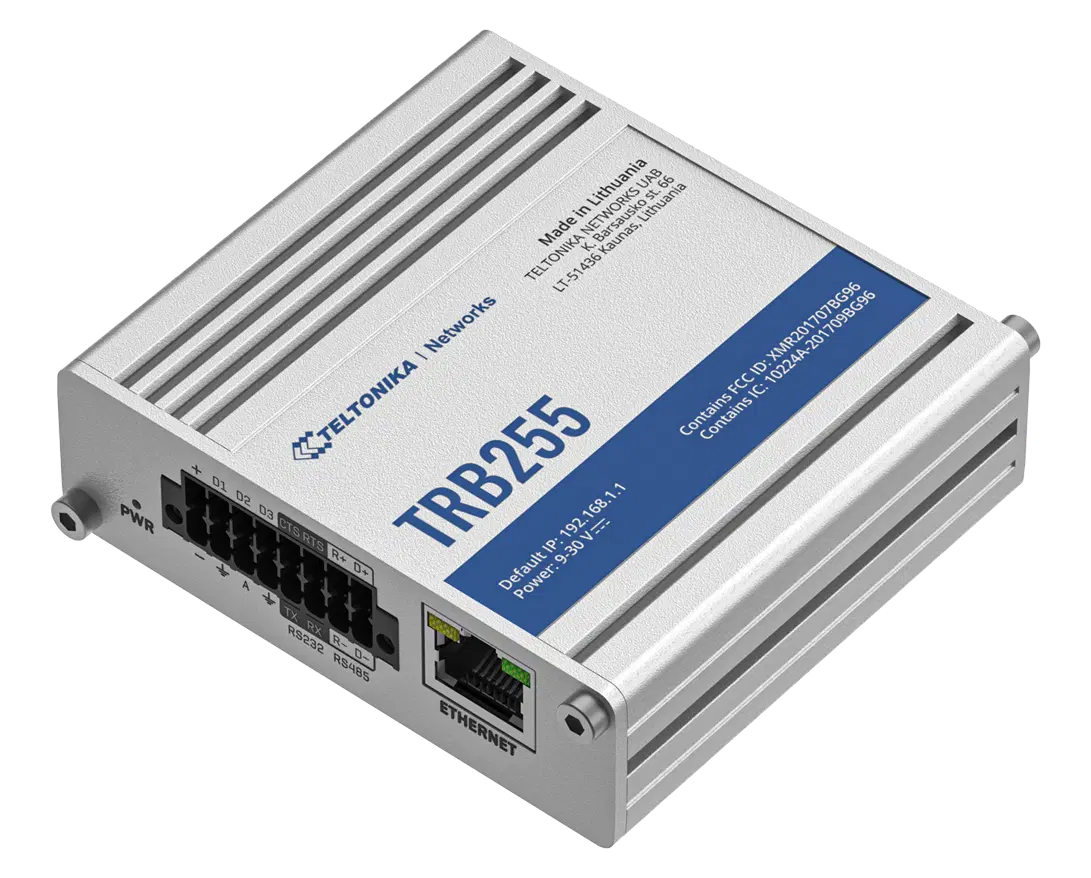
The Teltonika TRB255 is not a product made for home Wi-Fi users. It is a professional tool for engineers, system integrators, and operators who need a cellular router for IoT with multiple interfaces in one body. With LTE Cat 4 connectivity, Ethernet, RS232, RS485, and digital inputs and outputs, it offers flexibility for many industries. This Teltonika TRB255 review confirms that the router is best suited for sectors where uptime and integration are crucial. It provides stable communication for control systems, monitoring units, and connected devices. When paired with professional connectivity services, it becomes a reliable foundation for industrial networks.
Pros

Dual SIM keeps the connection alive by switching between carriers.
Remote monitoring and updates through Teltonika RMS.
Strong security with remote troubleshooting options.
Multiple ports (digital, serial, GNSS) for wide device support.
Works well for asset tracking, smart metering, and data systems.
Cons

No integrated Wi-Fi for local access
Not built for heavy multimedia traffic
Limited throughput compared to premium routers
Design & Build Quality
The Teltonika TRB255 router is housed in a metal case that protects it against dust, vibration, and temperature changes. Its size allows it to be mounted in small cabinets or vehicles, which is useful when space is limited. The design is not decorative but practical. Ports are placed logically, making it easier to connect cables in tight spaces.
This device is built for years of service. Industrial networks cannot afford equipment that needs constant replacement. The TRB255 meets this expectation with a solid enclosure and reliable internal design. In this Teltonika TRB255 review, durability stands out as one of the reasons why engineers often choose Teltonika.
Installation is simple. LED lights show the status of the router, signal, and connected ports. Even in environments where time matters, technicians can set it up quickly without advanced tools.
Features & Functionality
The Teltonika TRB255 is designed as a simple but capable unit for industrial use. It has no WAN port, only one LAN port for wired connections, and no Wi-Fi. For many projects, this is not a weakness, since stability is often more important than local wireless access. The router includes a networking interface with four pins in a 16-pin terminal block supporting TX, RX, RTS, and CTS. RS232 and RS485 are also present, making it possible to connect both new and older equipment still working in the field. In this Teltonika TRB255 review, such features show how the device fits into larger IoT networks.
Two SIM slots give flexibility for switching between operators. Connectivity covers LTE Cat M1, NB-IoT, and EGPRS, which is enough for monitoring, tracking, and control systems. Security is supported through VPN protocols, including OpenVPN, IPSec, GRE, and L2TPv3. A firewall, port forwarding, and Dynamic DNS add to the control options. Teltonika’s Remote Management System allows central supervision and firmware updates without sending people to the site. Power input works within 9 to 30 VDC and includes reverse polarity and surge protection. Power use is low, under 1.2 W when idle and under 5 W at peak. Two SMA connectors are fitted, one for LTE and one for GNSS. The Teltonika TRB255 is built specifically for industrial and IoT hardware. It connects both modern devices and legacy systems
Use Cases & Applications
Teltonika TRB255 is designed for specific environments. It is not an office router and does not pretend to be one. Its strength lies in connecting systems that keep industries running.
Manufacturing plants: It connects PLCs, meters, and sensors to central monitoring. By doing so, production lines can be monitored in real-time.
Energy sector: In smart grids, solar farms, and substations, it provides communication links between controllers and management software.
Transportation: It supports fleet management, ticketing systems, and communication with on-board equipment.
Remote sites: Mining, oil, and gas projects often work in places without fixed-line internet. The TRB255 becomes a bridge between field units and headquarters.
Digital signage: Advertising companies use it to control and update displays across cities without sending staff on-site.
These examples show how the Teltonika TRB255 router functions as a cellular router for IoT across different industries. It is not about raw speed but about steady communication where downtime is not an option.
Pricing & Value
In terms of cost, the Teltonika TRB255 stands in the middle range of industrial routers. It is more advanced than entry-level models but more affordable than modular gateways designed for large networks. The value comes from its ability to combine multiple interfaces in one unit. Instead of buying separate converters and adapters, businesses get everything in a compact router. This reduces maintenance and simplifies deployment.
When set against other routers, the TRB255 stands out for how it mixes steady performance with tough build and flexible ports. For system integrators, that balance often pays off in the long run, even if the upfront cost is a bit higher than simple consumer models.
In this industrial LTE router review, the cost-to-performance ratio makes sense for companies that want a reliable unit that can last for years.
Simbase Expert Recommendation
The Teltonika TRB255 review makes it clear that this router fits well in industries where connected systems must keep running. It is not built to be the fastest, and it is not packed with every new feature, but it gives a steady link, practical interfaces, and solid security that meet the needs of industrial work.
When paired with Simbase connectivity services, the value increases further. Simbase offers fixed IP IoT SIM cards, VPN options, and multi-network coverage. Together with the TRB255 hardware, these services build a system where communication is reliable across different regions and network conditions.
Final Verdict: For integrators, energy providers, fleet operators, and digital signage companies, the Teltonika TRB255 router is one of the best IoT routers available. It is not designed for entertainment or casual use. It is made to keep machines talking to each other without interruption. If your project requires an industrial LTE router that can handle multiple interfaces in one unit, the TRB255 is a safe choice.
Cta
Want to see how the Teltonika TRB255 and Simbase can power your next industrial project? Contact us today to learn more and get started.