


 All posts
The Hidden Cost of POTS Replacement: How Idle SIMs Increase Deployment Costs
When MSPs compare connectivity providers, the first number they usually look at is the monthly cost per SIM.
But that number only tells part of the story.
The real cost of POTS replacement connectivity includes every SIM that is active but not generating revenue. SIMs sitting in warehouse inventory, waiting in repair queues, assigned to decommissioned sites, or held for seasonal deployments all continue billing under most carrier plans.
For growing POTS replacement providers, these hidden costs can quietly add thousands of dollars to annual operating expenses.
In this article, we'll break down where those costs come from, how they impact profitability, and why your connectivity model matters just as much as your advertised per-SIM rate.
Where idle SIM costs add up
Warehouse inventory
Successful POTS replacement providers maintain inventory that is ready to deploy.
Many preconfigure ATAs with activated SIMs so technicians can install equipment immediately. Most operations keep between 10 and 20 percent additional inventory available for upcoming projects.
The problem is that many carrier plans begin billing as soon as a SIM is provisioned, not when it is installed.
For a deployment with 1,000 active sites and 15 percent warehouse inventory:
150 idle SIMs × $10 per month = $1,500 every month
Those SIMs generate no revenue, yet they appear on every carrier invoice.
RMA and repair inventory
Hardware occasionally fails.
When an ATA is replaced in the field, the original device enters the repair process. Unless someone manually suspends or cancels the SIM, monthly charges continue while the device sits in transit or waits for repair.
For many MSPs, repair inventory represents another 2 to 5 percent of their deployed SIM base.
Customer churn
Sites eventually close.
Businesses relocate, buildings change ownership, or customers cancel service. Even after a POTS replacement deployment is removed, the associated SIM often remains active until someone identifies it and manually deactivates the service.
Across hundreds or thousands of locations, this billing lag becomes surprisingly expensive.
Seasonal deployments
Not every deployment operates year-round.
Construction projects, event venues, temporary facilities, and seasonal retail locations may only require connectivity for part of the year.
If your carrier requires an active monthly plan to retain the SIM or phone number, those idle months become unnecessary operating costs.
How much do idle SIMs really cost?
Consider a POTS replacement provider managing 1,000 active sites using retail carrier SIMs at $10 per month.
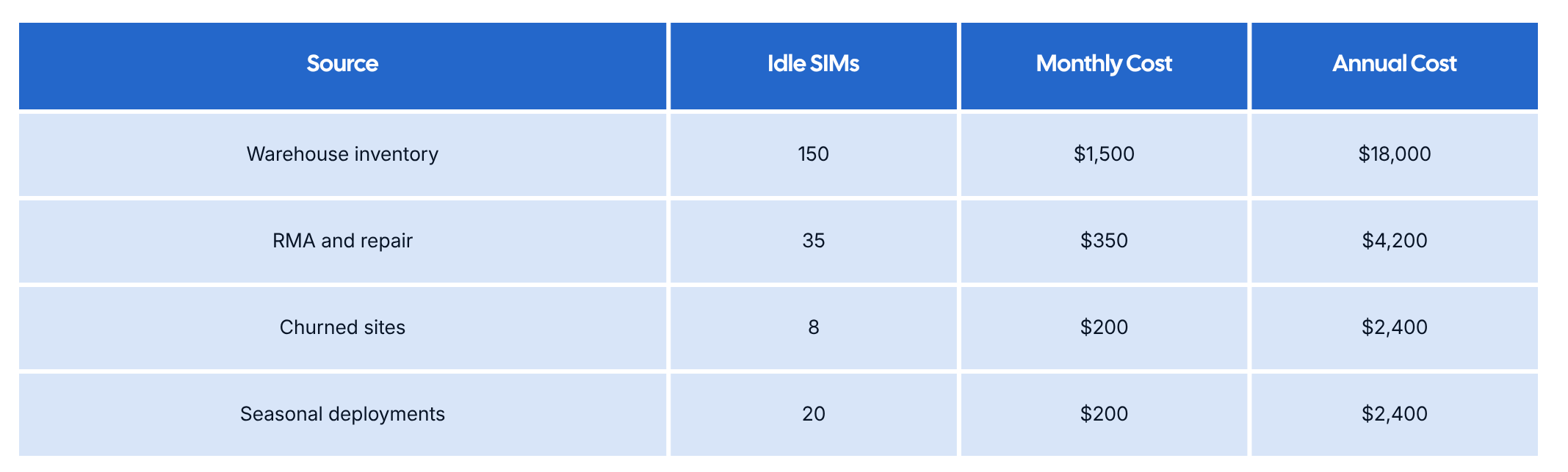
That represents $25,560 every year spent on SIMs that produce no revenue.
Over a typical 36-month deployment, those costs grow to $76,680.
For dual-SIM hardware, the total can exceed $150,000.
This is not simply a billing nuisance. It directly affects project margins and long-term profitability.
How utility pricing reduces idle SIM costs
A utility-based connectivity model separates billing from provisioning.
Instead of paying for every provisioned SIM, you only pay for SIMs that are actively deployed.
That changes every stage of a deployment lifecycle.
Warehouse inventory
Provision SIMs in advance and keep them ready to ship.
Billing begins only when the device is activated in the field.
Repair inventory
Pause connectivity while equipment is being repaired.
Resume service when the replacement device is installed.
Customer churn
Deactivate or pause SIMs immediately when a site is removed from service instead of paying for weeks or months of unnecessary billing.
Seasonal sites
Pause connectivity during the off-season and reactivate the same SIM when operations resume.
The result is simple.
Idle inventory no longer generates recurring monthly costs.
The operational benefit extends beyond cost savings
Reducing idle SIM charges also reduces administrative work.
Operations teams no longer spend hours identifying inactive SIMs, managing multiple carrier portals, disputing invoices, or tracking equipment moving through warehouse and repair processes.
Instead, connectivity becomes easier to manage because billing aligns with active deployments.
Active SIMs generate revenue.
Inactive SIMs do not generate charges.
Calculate your POTS replacement connectivity costs
If you're managing a growing fleet of POTS replacement deployments, calculate how much idle inventory may already be costing your business.
Count every provisioned SIM.
Count your active customer sites.
Calculate the difference.
Multiply that number by your monthly SIM cost.
Project the total over 36 months.
Many MSPs discover their hidden SIM costs are significantly higher than expected.
See how much you could save
Talk to one of our connectivity experts to compare your current connectivity costs with Simbase.