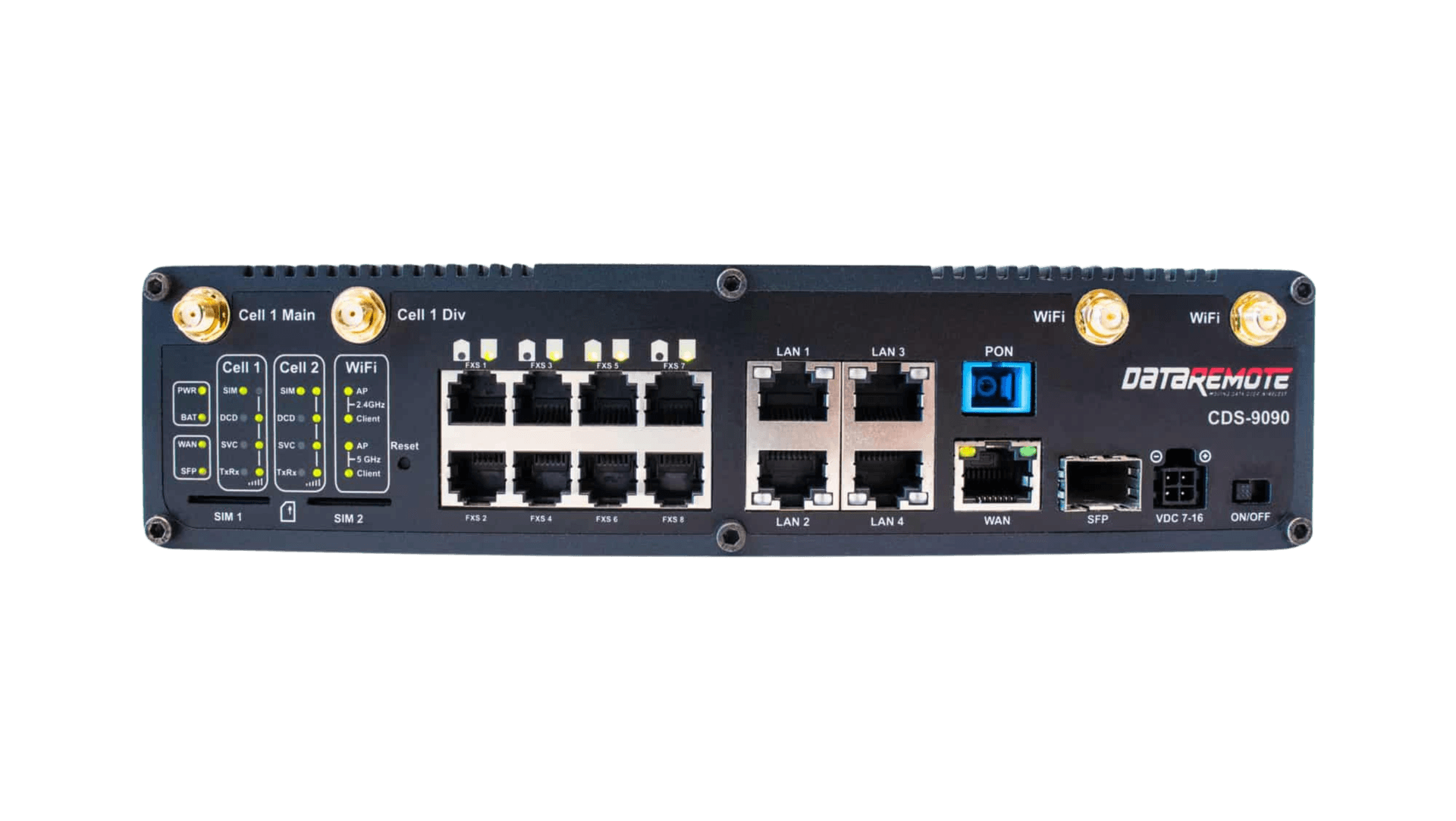
Built to replace traditional analog phone lines without the complexity of wireline infrastructure, the POTS IN A BOX® CDS-9090 delivers reliable cellular, WAN, and Band 14 connectivity for critical voice applications.
DataRemote CDS-9090 Verdict Summary
Design & Build Quality
Performance & Connectivity
Features & Functionality
Use Cases & Applications
Key features of DataRemote CDS-9090
Pricing & Value
Simbase Expert Recommendation
Technical Specifications
Get started with Simbase
Frequently Asked Questions
By Roel van der Meer
June 5, 2026
DataRemote CDS-9090 Verdict Summary
The DataRemote CDS-9090 is the most capable POTS replacement ATA on the market for multi-line enterprise deployments. With eight RJ-11 FXS ports, dual SIM slots, an integrated 12-hour battery backup, and support for voice, fax, alarm, modem, and M2M signals, it handles virtually every legacy analog application that previously relied on copper POTS lines. Built for MSPs and service providers deploying POTS replacement at scale, the CDS-9090 combines plug-and-play installation with enterprise-grade device management through DataRemote's Ara platform. It is UL-listed, Band 14 capable for FirstNet priority access, and designed to meet the reliability requirements of fire alarm panels, elevator phones, and other life-safety systems. However, the hardware is only half the equation. The SIM connectivity you pair with the CDS-9090 determines your per-site economics, failover reliability, and operational complexity at scale. This review examines both the hardware and the connectivity layer — and makes the case for why multi-carrier cellular from Simbase is the optimal pairing.
Pros
8 FXS port, highest density in its class
12-hour integrated battery backup
Dual SIM slots for carrier redundancy
Band 14 / FirstNet capable
Supports voice, fax, alarm, modem, M2M
Ara device management platform
UL 60950-1 listed
Cons
LTE Cat 4 only. For 5G, DataRemote offers the eight-line 90X1, with the 90X5 forthcoming.
Larger form factor than 1–2 line devices
SIM connectivity sourced separately
Design & Build Quality
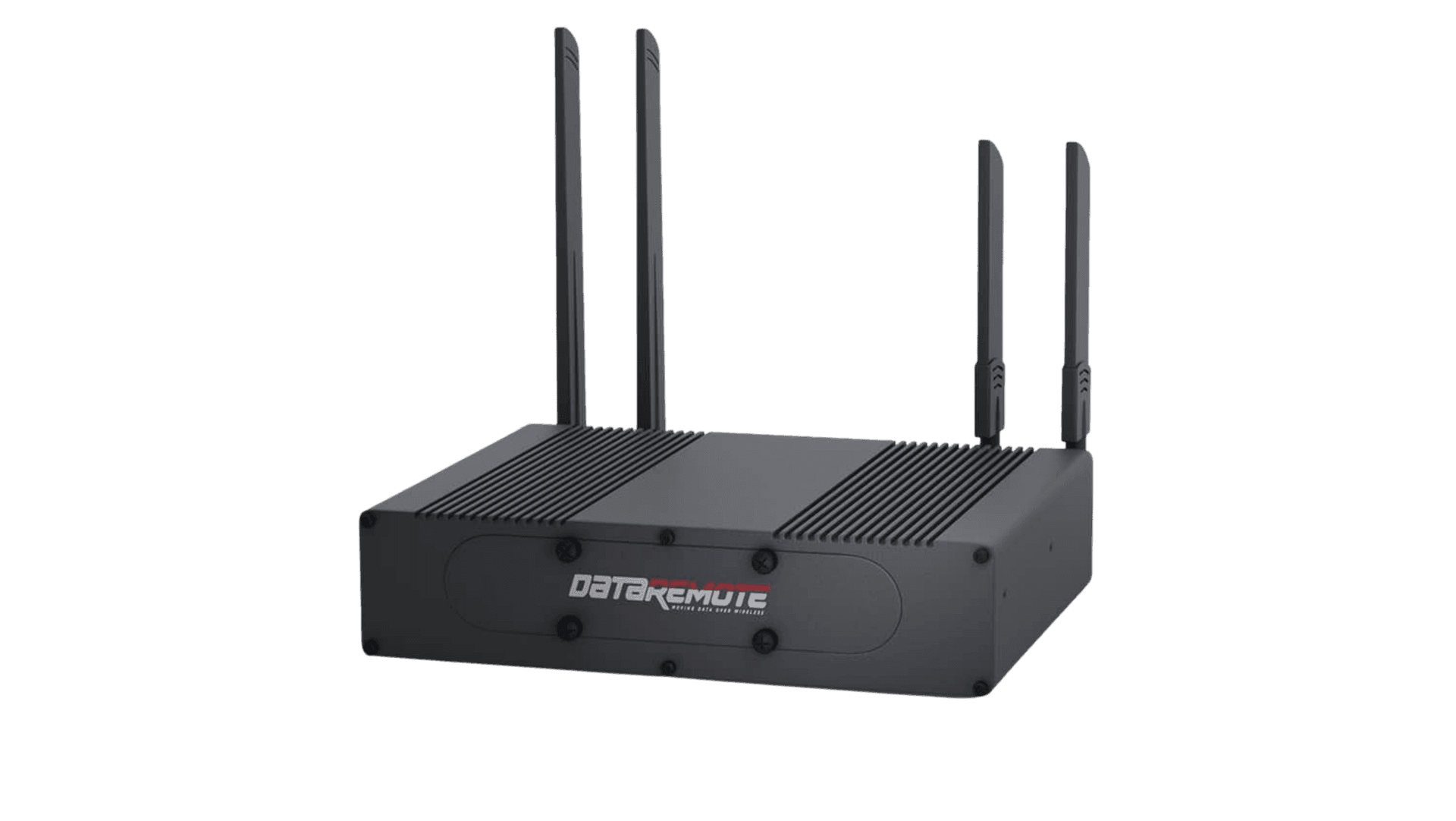
The CDS-9090 is built for commercial and industrial environments. The black aluminum extrusion case measures 13” × 10” × 3” and weighs 7.5 lbs — substantial enough to convey durability, compact enough to mount in a standard telecom closet or equipment room. A wall-mounting bracket is included in the box.
The rear panel is well-organized: eight RJ-11 FXS ports across the top, five RJ-45 Ethernet ports below (1 WAN/SFP combo + 4 Gigabit LAN), four external antenna connectors (2 LTE, 2 dual-band Wi-Fi), USB 3.0 and 2.0 ports, and a DC power input with a locking 4-pin plug. LED status indicators on the front panel provide at-a-glance diagnostics for power, battery, cellular signal, and line status.
The dual SIM card slots are accessible without disassembling the unit, which matters for field technicians swapping SIMs across deployments. The hot-swappable lithium-ion battery (7.4V, 10,000mAh) slides in and out cleanly and provides up to 12 hours of standby operation — a critical feature for life-safety applications that must stay online during power outages.
Build quality is excellent. The CDS-9090 meets GR-63-CORE shock standards (tested to a 75cm / 30-inch drop) and operates across a temperature range of -5°C to +50°C. For POTS replacement deployments in elevator machine rooms, parking garages, and outdoor enclosures, this durability matters.
Performance & Connectivity
The CDS-9090 runs on an LTE Cat 4 cellular modem supporting bands 2, 4, 5, 12, 13, 14, and 71 — covering all major US carrier frequencies including Band 14 for FirstNet priority access. This is important for deployments in public safety environments where fire alarm panels and emergency call boxes require priority network access during emergencies.
For POTS replacement, raw throughput matters less than connection stability and voice quality. The CDS-9090 delivers PESQ scores above 4.3 on G.711 and 3.7 on G.729 — well above the threshold for reliable voice communication over cellular. Echo cancellation, in-band and out-of-band DTMF support, and full E911 compliance ensure that the analog services running through the device perform as expected.
The dual SIM architecture is where the CDS-9090’s connectivity design gets interesting. With two SIM slots, the device can maintain profiles on two separate carriers, providing automatic failover if the primary carrier experiences an outage. This is the standard approach for MSPs deploying POTS replacement at scale — but how you fill those slots has significant implications for cost, management complexity, and actual failover performance.
Wi-Fi connectivity (dual-band 802.11 b/g/n at 2.4GHz and 802.11 a/ac at 5GHz) provides an additional connectivity path, while the Gigabit Ethernet ports support WAN failover from a wired broadband connection. The device can route traffic across cellular, Wi-Fi, and wired connections, providing multiple layers of redundancy.
Understanding POTS Replacement: POTS (Plain Old Telephone Service) refers to the traditional analog copper phone lines that have connected fire alarms, elevators, security systems, and voice lines for decades. As AT&T, Verizon, and Lumen retire their copper infrastructure, businesses must migrate these critical connections to cellular alternatives. A POTS replacement ATA (Analog Telephone Adapter) like the CDS-9090 plugs directly into existing analog equipment and routes signals over LTE cellular networks instead of copper — keeping legacy devices operational without replacing the equipment itself.
Features & Functionality
The CDS-9090’s feature set is purpose-built for POTS replacement. Where general-purpose LTE routers require workarounds to handle legacy analog signals, the CDS-9090 handles them natively.
8 FXS ports. The highest port density in the POTS IN A BOX lineup. Each port supports independent line configurations — voice, fax, alarm, modem, or ring-down — allowing a single device to replace up to eight copper POTS lines at a site.
Proprietary analog replacement technology. DataRemote’s Enhanced Lines technology goes beyond standard VoIP to support legacy analog signals including FSK modem tones, fire alarm protocols, burglar alarm signals, and fax transmission. This is critical for applications where standard SIP/VoIP solutions fail.
12-hour battery backup. The integrated lithium-ion battery provides extended operation during power outages. For fire alarm panels and elevator phones that must comply with code requirements for backup power, this is a differentiator over competing devices that require external UPS equipment.
Band 14 / FirstNet capable. When optioned for Band 14, the CDS-9090 can access FirstNet priority and preemption on the AT&T network. This is relevant for deployments in government buildings, hospitals, and public safety facilities.
Ara device management. DataRemote’s hosted device management platform enables remote provisioning, real-time monitoring, firmware updates, and mass device management via MQTT. Its API supports integration with MSP billing and ticketing systems, while SOC 2 compliance provides an added layer of assurance around platform security and data protection.
Automatic cellular failover. If the primary cellular connection drops, the device automatically switches to the secondary SIM. Combined with WAN/Wi-Fi failover paths, the CDS-9090 provides multiple layers of connectivity redundancy.
E911 with GNSS location. Integrated GNSS provides precise location data for E911 compliance — a legal requirement for voice lines in commercial buildings.
Graceful battery shutdown. When battery power reaches critical levels, the device sends an alert before shutting down, giving monitoring systems time to register the status change rather than losing contact without warning.
Use Cases & Applications
The CDS-9090 is designed for sites where multiple POTS lines need to be replaced simultaneously. Its eight-port design makes it most cost-effective at multi-line locations rather than single-line deployments.
Fire Alarm Panels
Fire alarm systems are the most compliance-sensitive POTS replacement application. The CDS-9090 supports the analog signaling protocols required by fire alarm communicators, maintains battery backup for code compliance, and provides the line-monitoring capabilities that fire marshals and authorities having jurisdiction (AHJs) require. With Band 14 support, deployments in government and public safety buildings gain FirstNet priority access.
Elevator Phones
Building code requires working elevator phones in most jurisdictions. The CDS-9090’s ring-down capability and voice quality make it suitable for elevator emergency phone lines. The battery backup ensures the phone line stays active even during the building power outages that are most likely to trigger elevator emergencies.
Burglar and Security Alarm Systems
Legacy alarm panels that communicate via analog phone lines to central monitoring stations can connect directly to the CDS-9090’s FXS ports. The device supports the DTMF and FSK signaling protocols these panels use, avoiding the need to replace the entire alarm system when the copper line is retired.
Multi-Tenant Commercial Buildings
A single CDS-9090 can replace up to eight copper lines at a commercial site — handling the fire panel, elevator phone, security system, gate access, intercom, fax machine, and building management system from one device. This consolidation reduces equipment, installation time, and ongoing management.
Point of Sale and ATM Terminals
Retail and banking locations with legacy POS terminals or ATMs that still communicate over analog modem connections can use the CDS-9090 to maintain those connections after copper retirement without replacing the terminal hardware.
Key features
Key Features of DataRemote CDS-9090
Cellular
LTE Cat 4 (Bands 2, 4, 5, 12, 13, 14, 71)
FX Ports
8 x RJ-11
Supported Services
Voice, fax, alarm, modem, M2M, SCADA, ring-down
Slots
2 (dual carrier failover)
Battery
12-hour lithium-ion, hot-swappable
Certifications
UL 60950-1, UL 2054 (battery)
Pricing & Value
The CDS-9090 is priced at the higher end of the POTS replacement ATA market, reflecting its eight-port capacity, integrated battery, Band 14 support, and enterprise device management capabilities.
For deployments requiring additional power resiliency, DataRemote’s 90X2 also supports eight lines but is larger than the CDS-9090 and offers up to 48 hours of battery backup. It also features a patented UPS output designed to provide backup power to supported third-party devices.
For multi-line sites, the CDS-9090’s eight-port design allows MSPs to consolidate multiple copper lines onto a single device, potentially reducing the amount of hardware required at each location. Total cost of ownership, however, also depends heavily on the connectivity model.
The hardware cost is fixed regardless of SIM choice. Connectivity represents an ongoing cost across the life of the deployment, giving MSPs an opportunity to improve long-term economics and recurring margins by optimizing their cellular connectivity costs at scale.
Simbase Expert Recommendation
The DataRemote CDS-9090 is the most capable POTS replacement ATA available for multi-line enterprise deployments. For MSPs replacing copper at commercial buildings, hospitals, multi-tenant properties, and public safety facilities, it is the hardware standard.
Paired with Simbase multi-carrier cellular connectivity, the CDS-9090 becomes the lowest total-cost-of-ownership POTS replacement solution on the market. Multi-IMSI failover eliminates the slow modem-level SIM switching that compromises life-safety reliability. Utility pricing eliminates the idle inventory waste that erodes MSP margins. A single management portal eliminates the operational complexity of juggling multiple carrier relationships.
Our conclusion: The CDS-9090 is the right hardware for serious POTS replacement deployments. Simbase is the right connectivity to put inside it. Together, they give MSPs the reliability, economics, and operational simplicity to scale profitably through the copper retirement cycle.
Technical Specifications
Characteristics
Diagram
FXS Ports
8 x RJ-11
Ethernet Ports
1 x WAN/SFP combo + 4 x Gigabit LAN (10/100/1000)
Cellular Modem
LTE Cat 4
LTE Bands
2, 4, 5, 12, 13, 14, 71
Wi-Fi
2.4GHz (802.11 b/g/n, MIMO 300Mbps) + 5GHz (802.11 a/ac, MIMO 867Mbps)
SIM Slots
2 x SIM card slots (multi-carrier)
USB
USB 3.0 + USB 2.0
Antennas
4 external: 2 x LTE, 2 x dual-band Wi-Fi (2.4GHz + 5GHz)
If any of your questions remain unanswered, reach out to our team to answer them for you.
What applications does the CDS-9090 support?
The CDS-9090 supports voice (VoIP over LTE), fax, fire alarm signals, burglar alarm signals, elevator emergency phones, ring-down lines, analog modem data (FSK), point-of-sale terminals, ATM communications, SCADA/telemetry, automatic meter reading, and emergency call boxes. If it previously ran over a copper POTS line, the CDS-9090 can handle it.
How many POTS lines can one CDS-9090 replace?
Up to eight. The CDS-9090 has eight RJ-11 FXS ports, each configurable independently for different line types (voice, fax, alarm, modem, ring-down). This makes it ideal for multi-line commercial sites where a single device can replace all copper lines.
Does the CDS-9090 work with Simbase SIMs?
Yes. Simbase multi-IMSI eSIMs are compatible with the CDS-9090’s dual SIM slots. A single Simbase SIM provides access to AT&T, Verizon, T-Mobile, and US Cellular with automatic carrier failover at the SIM layer — replacing the need for two separate retail carrier SIMs.
What happens during a power outage?
The CDS-9090 includes an integrated 12-hour lithium-ion battery that is hot-swappable. When AC power is lost, the device switches seamlessly to battery operation. Before the battery is depleted, the device sends a graceful shutdown alert so monitoring systems can register the status change.
Is the CDS-9090 compliant for fire alarm applications?
The CDS-9090 is UL 60950-1 listed and supports the analog signaling protocols used by fire alarm communicators. Its 12-hour battery backup and line-monitoring capabilities support the requirements set by fire marshals and authorities having jurisdiction (AHJs). Band 14 / FirstNet capability provides priority access for public safety deployments.




 8 FXS port, highest density in its class
 LTE Cat 4 only. For 5G, DataRemote offers the eight-line 90X1, with the 90X5 forthcoming.