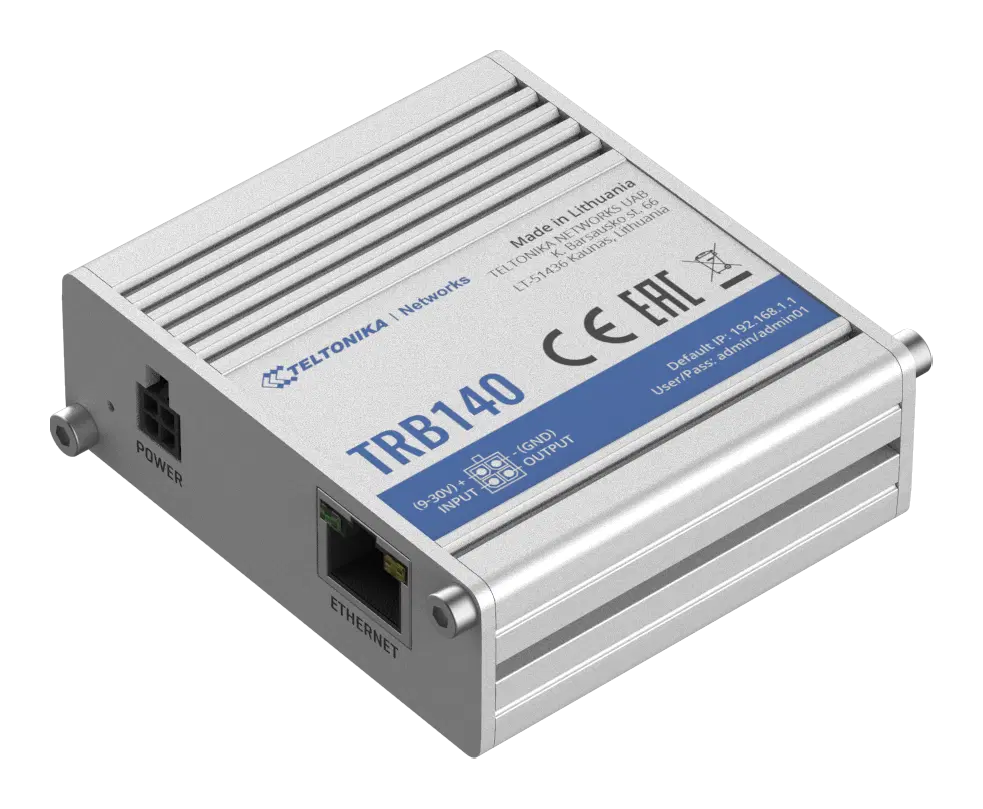
The Teltonika TRB140 router is a smart pick for engineers, system integrators, and operations managers who need stable mobile connectivity in harsh conditions or remote setups. It gives a steady link even in isolated areas, and its small frame hides serious power. In all the Teltonika TRB140 reviews, the device shows strong build quality, consistent throughput, and simple setup. It handles daily loads in industrial environments and pairs well with remote management systems. If you need a basic but solid cellular router for IoT, this one covers the core needs without asking for too much space, power, or attention.
Pros

Built-in firewall and OpenVPN support for safe connections.
Remote Management System (RMS) for easy remote setup and control.
Works in extreme temperatures from -40°C to 75°C.
Compact size fits into tight industrial spaces.
Strong metal casing protects against dust and impact.
Cons

Only one Ethernet port
No Wi-Fi support
Limited use for high-bandwidth needs
Fixed SIM slot (no dual SIM for failover)
Design & Build Quality
The outer case of the Teltonika TRB140 is made of metal. That alone gives it a serious edge for places where temperature, dust, or minor impacts could damage plastic-bodied devices. The shell also helps with passive cooling. It works in temperatures from -40°C to 75°C, which is enough for most outdoor or factory settings.
Its compact form makes it a good fit for DIN rails, wall mounts, or back panels. Installers don’t need to make space for a full-size router. It sits quietly and stays out of the way.
From our industrial 4G router review sessions, TRB140 installs fast. The screw terminals, antenna slots, and single Ethernet port are all easy to access. This makes field swaps or upgrades quick, which is helpful in remote or high-risk environments where every minute counts.
Features & Functionality
The Teltonika TRB140 router offers a narrow, focused setup. It is not built for full networks. It connects one device, through one port, to the mobile internet. That’s the job. Inside, there’s an LTE Cat 4 modem. It handles 4G, 3G, and 2G. Speeds reach up to 150 Mbps. One Ethernet port. One micro SIM slot. One microUSB.
It runs under 5 watts. Power input from 9 to 30 VDC. Surge protection kicks in at 31 VDC. That helps in unstable power setups. Security is handled by a built-in firewall. It blocks traffic by the rules. You can also set up OpenVPN, IPSec, GRE, or L2TP tunnels. These are enough for most secure links.
You get SMS control and remote management. Teltonika RMS connects everything. From one place, you can update firmware or change settings. It makes large rollouts easier.
There’s no Wi-Fi. No WAN port. It’s a single-SIM slot device. It keeps the list short. But it works. And that’s what people want when the connection matters. In this Teltonika TRB140 review, it still shows why it’s considered one of the best cellular routers for IoT. Simple, strong, and made for real tasks.
Use Cases & Applications
The TRB140 is used in:
Energy: connecting smart meters, battery storage units, and solar panel controllers
Transport: managing ticket machines, signal boxes, and remote gates
Retail: linking kiosks, vending machines, or ATMs
Industry: sending machine status updates or SCADA signals
Anywhere that has power but no wired internet, this device can be dropped in. Its small size, strong casing, and stable link make it a go-to choice.
In our Teltonika TRB140 review, we tested it in both urban and rural settings. In a city kiosk, the device held a connection without visible lag. In a wind farm control panel, it delivered logs on schedule despite low signal areas.
Compared to full-size routers, the Teltonika TRB140 router is less flexible, but in the right setting, it’s more stable.
Pricing & Value
Compared to larger LTE routers, the Teltonika TRB140 is affordable. In many shops, it sells for about $130–$260. This puts it well below other units with dual SIM, Wi-Fi, or multiple LAN ports.
The low price comes with tradeoffs, but in single-device use cases, it’s a smart buy. The power draw is minimal, the form factor fits in tight spaces, and the setup time is short. Looking at industrial LTE routers in the same bracket, few offer the same build strength and OS support. The RMS compatibility adds value too, especially for system integrators or IT teams managing dozens of units.
When reviewing cost over time, this cellular router for IoT shows low failure rates and long uptime. It works silently in the background, which saves money on service visits or IoT hardware swaps.
Simbase Expert Recommendation
In our view, the Teltonika TRB140 router fits perfectly with Simbase’s multi-network SIMs, fixed IP plans, and VPN support. When paired with an IoT SIM card that allows multiple provider access, the TRB140 becomes even more stable. This reduces downtime in rural or low-signal areas.
With a Simbase VPN and fixed IP setup, the router can be reached remotely without port-forwarding tricks. That makes life easier for technicians and speeds up updates or fixes.
For partners or system vendors building long-term solutions, the Teltonika TRB140 gives a strong hardware base. It’s small, durable, and trusted by field engineers. For projects that need one device to connect securely and stay live for years, it meets the mark.
Cta
Need reliable remote access? Set up the Teltonika TRB140 with a Simbase SIM and a fixed IP address. Contact us to get started.