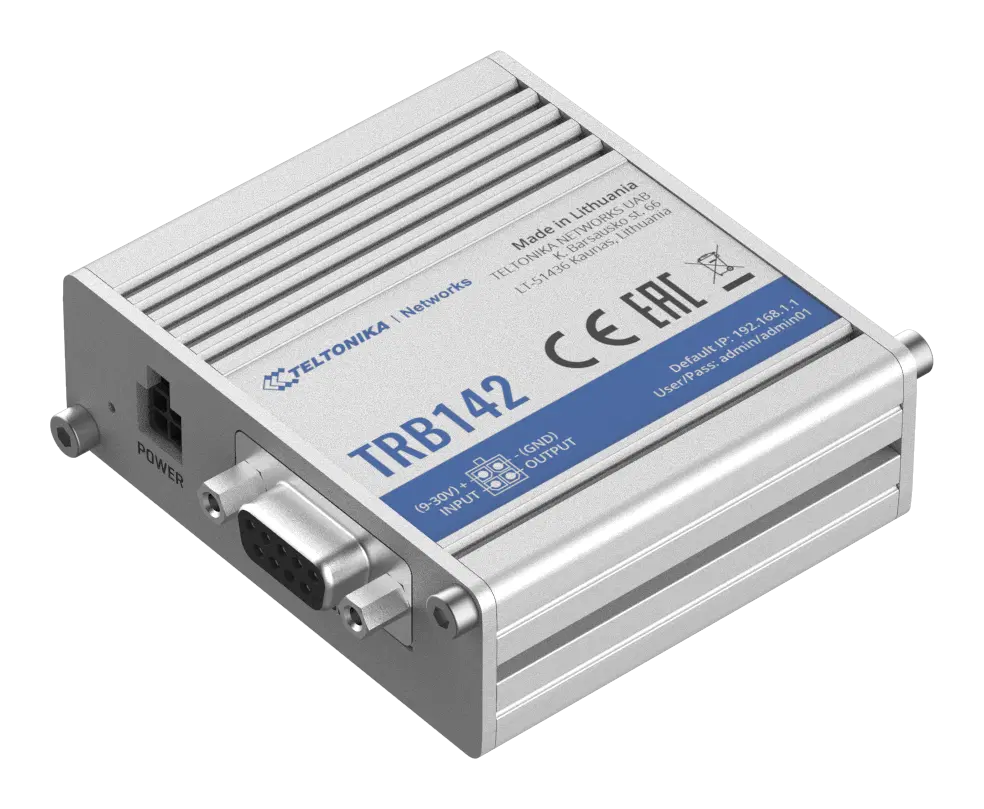
The Teltonika TRB142 router fits industrial needs where a serial port is required. It serves companies that operate legacy equipment, control systems, or machines that still use RS232 but need mobile internet. It bridges IoT hardware with modern networks. In this Teltonika TRB142 review, the router stands out for its compact size, durable case, and reliable LTE Cat 1 performance. It handles narrowband tasks like telemetry, control commands, and remote monitoring. While it won’t support video streaming or heavy downloads, it was never meant to. This is an industrial LTE router built for stability and low data loads. Its support for VPN, firewall rules, and remote management adds to its reliability. When paired with Simbase connectivity, it can serve in many remote, mobile, or embedded systems with zero fuss.
Pros

RS232 serial port for legacy systems
Strong build, compact size
Secure and stable LTE Cat 1 connection
Supports remote management via RMS
Works with Simbase SIMs and VPN settings
Cons

No Wi-Fi
Limited to a single Ethernet port
LTE Cat 1 speed is low by design
Design & Build Quality
The Teltonika TRB142 router has a small, metal housing with mounting holes, making it easy to fix in cabinets, machines, or control boxes. It fits tight spaces. The housing protects against dust, vibration, and minor impacts. This is common in setups like factories, power stations, or traffic systems.
The weight is light, and the layout is clean. The RS232 port is placed firmly on the front. The IoT SIM card slot is reachable and doesn't require special tools. LEDs show power, network, and connection status. Even without a screen, you can check its condition at a glance.
The device can run for months without a restart. It is built to stay online in places where people may not visit for weeks.
Features & Functionality
What separates the Teltonika TRB142 from others is its serial interface combined with LTE. RS232 is not common in new routers, but it remains in many industries. This gateway is a bridge between two generations.
The TRB142 includes:
LTE Cat 1 support
One RS232 port (DB9 connector)
One Ethernet port
VPN options (IPSec, OpenVPN, PPTP, L2TP)
Firewall with filtering rules
Remote control via Teltonika RMS
SMS commands
It works well with Simbase fixed IP SIMs, letting users build remote control systems with static endpoints. Firewall settings are basic but allow safe port forwarding. SMS reboot is available, which helps when the internet fails but the mobile signal is present.
Security settings are simple to apply. Users can close ports, limit access, and filter IPs. RMS adds another layer, with tools for firmware updates, stats, and alerts from anywhere.
This industrial LTE router does not support Wi-Fi, but in this case, it is a strength. Fewer services mean fewer risks. It does one job and does it well.
Use Cases & Applications
The Teltonika TRB142 router is designed for industrial setups. It is used in places where RS232 devices need remote control, telemetry, or fault reporting.
Some examples:
Power grid equipment (relays, meters)
Manufacturing systems with serial PLCs
Traffic lights and control units
ATMs and payment kiosks
Water treatment plant sensors
SCADA systems
Remote building access controls
During this Teltonika TRB142 review, we tested the router with a Modbus serial sensor. The device logged temperature and humidity data and sent it every 30 seconds to a cloud platform. Even under poor signal, the logs arrived without errors.
This makes it a good fit for harsh or mobile environments. It can be used in trains, road vehicles, or containers. If combined with Simbase IoT SIM cards, the unit gains a direct, secure route to HQ servers without relying on public IP exposure.
Pricing & Value
The Teltonika TRB142 is priced around $110 to $140, depending on region and reseller. Compared to other industrial LTE routers, it is not the cheapest, but it brings value in its niche.
Most routers in this range do not include a serial port. Others offer RS485, not RS232. If your device needs RS232 and your network needs mobile access, this router is one of the few that covers both without extra modules.
When reviewed against other models like the TRB145 (RS485), TRB140 (Ethernet only), and RUT200 (general use), the Teltonika TRB142 router sits at a point where special use and low power needs meet.
For projects where downtime costs money, it pays off in reliability. Maintenance is low, and remote access reduces travel and physical checks. Simbase also offers connectivity plans that fit this router’s profile. This reduces the need to shop for SIMs or VPN settings separately.
Simbase Expert Recommendation
In our Teltonika TRB142 review, the Teltonika TRB142 proves to be a smart tool for specific jobs. It is not a general-purpose router. It is made for machines, meters, and panels that were built in an earlier age but still run key processes.
For teams working in utilities, transportation, or automation, this cellular router for IoT offers peace of mind. It runs on LTE Cat 1 to match slow but constant data needs. It avoids complexity. It keeps the link live without fuss. That is why it earns 4.5 out of 5.
If your use case matches the features of this router, we recommend bundling it with Simbase connectivity. Static IP, encrypted VPN tunnels, and fixed cost plans make it easier to scale. You get control, reach, and durability in one simple setup.
The Teltonika TRB142 router may be small, but in the right place, it can be the key to keeping your network alive. Reliable, secure, and tested in the field, it is among the best IoT routers for legacy industrial systems.
CTA
Ready to connect legacy systems with modern reliability? Pair the Teltonika TRB142 with Simbase connectivity to keep your equipment online, secure, and easily managed.