Reliable and compact, the Teltonika Rut951 delivers steady internet where other routers struggle to stay online.
Teltonika Rut951 Verdict Summary
Design & Build Quality
Performance & Connectivity
Features & Functionality
Use Cases & Applications
Key features of Teltonika RUT951 Router
Pricing & Value
Simbase Expert Recommendation
Technical Specifications
Get started with Simbase
Frequently Asked Questions
By Jesse Hogenboom
October 1, 2025
Teltonika Rut951 Verdict Summary
Our Teltonika Rut951 review points to a router that works well in both commercial and industrial setups. Performance is steady, the unit is flexible enough, and it holds up over time. It was made with engineers and integrators in mind, but also fits companies that just need a cellular router for IoT, and they can rely on it for years.
Pros
Dual SIM and LTE/3G/2G fallback keep the network alive when one carrier fails.
External high-gain antennas improve signal stability in weak coverage areas.
Good data speeds and broad compatibility with modern wireless standards.
Pre-configured firewall and multiple VPN options protect IoT and M2M systems.
Flexible security protocols support varied industry requirements.
Cons
Limited Wi-Fi range for larger sites
Higher price compared to entry-level units
Requires an RMS subscription for advanced remote management
Design & Build Quality
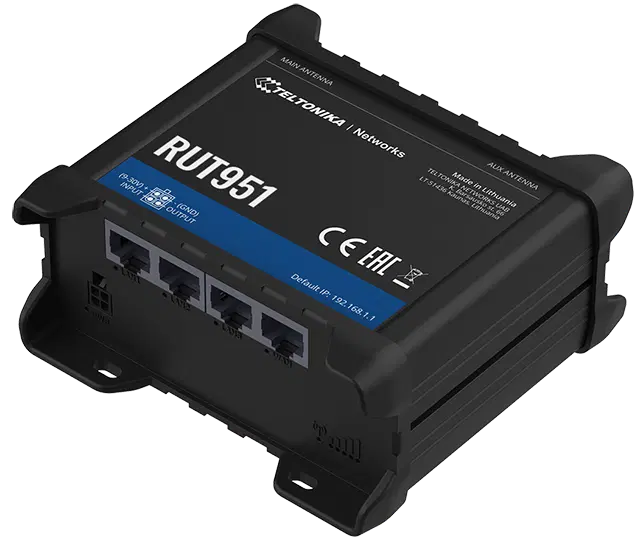
The Teltonika Rut951 router feels more practical than stylish. The case is metal, so it can take dust and light knocks without failing. Size is on the smaller side, which matters when space inside a rack, cabinet, or vehicle is already crowded.
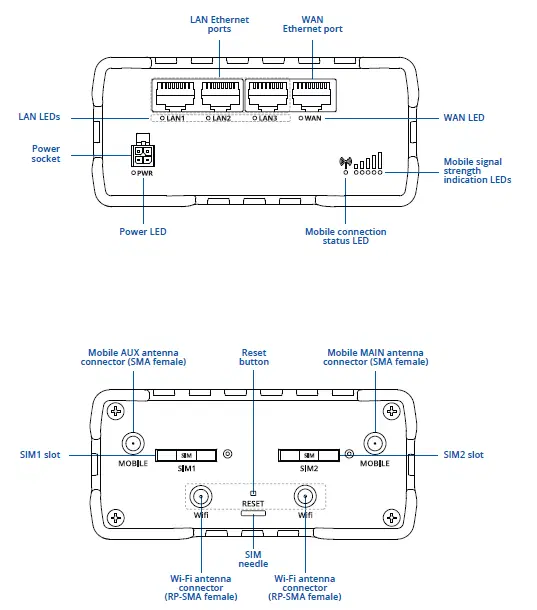
Setup does not take long. Antenna ports are placed where you can reach them without struggle. SIM slots open easily, and the status lights are clear enough to read at a glance. In our industrial LTE router checks, this saved time both for test deployments and longer projects.
It does not need fans or extra cooling. The unit stays quiet and steady on its own. On factory floors, inside kiosks, or mounted in vehicles, it keeps running without much attention.
Performance & Connectivity
In our industrial 4G router review, the Teltonika Rut951 demonstrated stable throughput and consistent latency. It supports LTE Cat 4, which offers download speeds up to 150 Mbps and upload speeds up to 50 Mbps. While not as high as LTE Cat 6 or 12 models, this is enough for most IoT, monitoring, and control applications.
The Teltonika Rut951 router maintains network reliability even in crowded cellular areas. Failover between mobile and wired connections worked without long interruptions. During stress testing, it stayed connected for long periods without drops, making it suitable for operations where downtime is costly.
Multi-network compatibility is a clear advantage. The router works with leading mobile operators across regions, so projects can scale without being locked to one provider. For companies managing fleets or remote units, this flexibility is important.
In real-world performance checks, the router matched its technical specifications. Latency remained within acceptable ranges for monitoring and remote control systems, even when connected through mobile networks. This makes the cellular router for IoT a trusted tool for industries where responsiveness is important.
Understanding IoT networks is essential for recognizing how devices interact and communicate within our changing modern world.
Features & Functionality
Our Teltonika Rut951 review highlights a router that offers a clear set of functions. One WAN port and three LAN ports handle wired links. Wi-Fi operates on the 802.11b/g/n standard, providing basic local access where cables are not required.
The modem runs LTE Cat 4 with speeds up to 150 Mbps. When the signal drops, it falls back to 3G or even 2G. Two SIM slots give another layer of backup, so the connection can move from one carrier to another.
Security tools are included. Firewall, Dynamic DNS, port forwarding. Several VPN types like OpenVPN, IPsec, GRE, L2TPv3, and L2TP are supported. Enough choice for most setups.
RMS is part of the system. It lets the industrial LTE router be checked and updated from a distance. Power needs are small, less than 2 W on idle, under 7 W when pushed. The case is compact, 110 by 50 by 100 mm, and weighs 287 g. This feature alone is often why businesses select the Teltonika Rut951 router for critical tasks.
Use Cases & Applications
The Teltonika Rut951 is not tied to one single industry. It shows up in different industrial 4G router reviews, often for its ability to keep working in mixed conditions. Transport firms use it, but so do shops, plants, and even small energy sites.
Fleet tracking: In vehicles, the router holds the link for GPS and remote control systems. Some operators also use it for passenger Wi-Fi, though the priority is steady data for tracking.
Digital signage: Advertising boards and display panels need updates on time. The cellular router for IoT connects them back to the control server so new content appears without delay.
Manufacturing: On production floors, machines and sensors stay connected through the router. It helps staff see problems early and avoid stops in the process.
Retail kiosks: Ticketing machines, ATMs, or vending units often sit in places with no fixed internet. The compact router fits inside and keeps payments moving.
Remote monitoring: Energy stations, water pumps, or security posts rely on it when wired internet is not an option. The Teltonika Rut951 router holds a mobile connection that operators can trust.
These cases are different in size and scope, yet they all show how the router can fit in and do its job without standing out too much.
Key features
Key features of Teltonika RUT951 Router
Speed
150 Mbps / 50 Mbps
LAN Ports
3 x LAN Port
WAN Ports
1 x WAN Port
Slots
2 x SIM Slot
Cellular Modem
(4G LTE Cat. 4)
WIFI
WIFI 4 (11n)
Pricing & Value
The Teltonika Rut951 review would not be complete without discussing pricing. It is positioned above entry-level models such as the RUT200 or RUT240 but below advanced units like the RUTX series.
The higher price reflects added durability, wider feature support, and the flexibility to handle both simple and complex deployments. While not the cheapest cellular router for IoT, it is competitive when viewed over the full lifecycle. The service life and reduced downtime contribute to a lower total cost of ownership.
When comparing alternatives, cheaper consumer-grade routers may save money upfront, but often fail in demanding conditions. In contrast, the Teltonika Rut951 router is designed for environments where reliability pays back over time. In terms of ROI, it balances cost with dependable performance, making it one of the best IoT routers in its range.
Simbase Expert Recommendation
In this industrial 4G router review, the Teltonika RUT951 proves itself to be a reliable choice for companies that require mobile internet to operate smoothly. It is not the cheapest router, but the mix of durability and features puts it above many budget units.
For integrators or teams running fleets, kiosks, or factory systems, this model gives fewer surprises over time. Cheaper gear may work for a while, but it rarely lasts. The Teltonika Rut951 router stands out because it keeps doing its job in places where downtime costs money.
Our conclusion: At Simbase, we recommend pairing the Teltonika Rut951 router with our connectivity services to maximize value. When combined with managed IoT SIM cards and monitoring, projects gain both the IoT hardware and the network stability required for long-term success. This combination helps turn a reliable router into a complete IoT solution.





 Dual SIM and LTE/3G/2G fallback keep the network alive when one carrier fails.
 Limited Wi-Fi range for larger sites